Know and control everything AI that runs
One live inventory across all vendors, online or CLI.
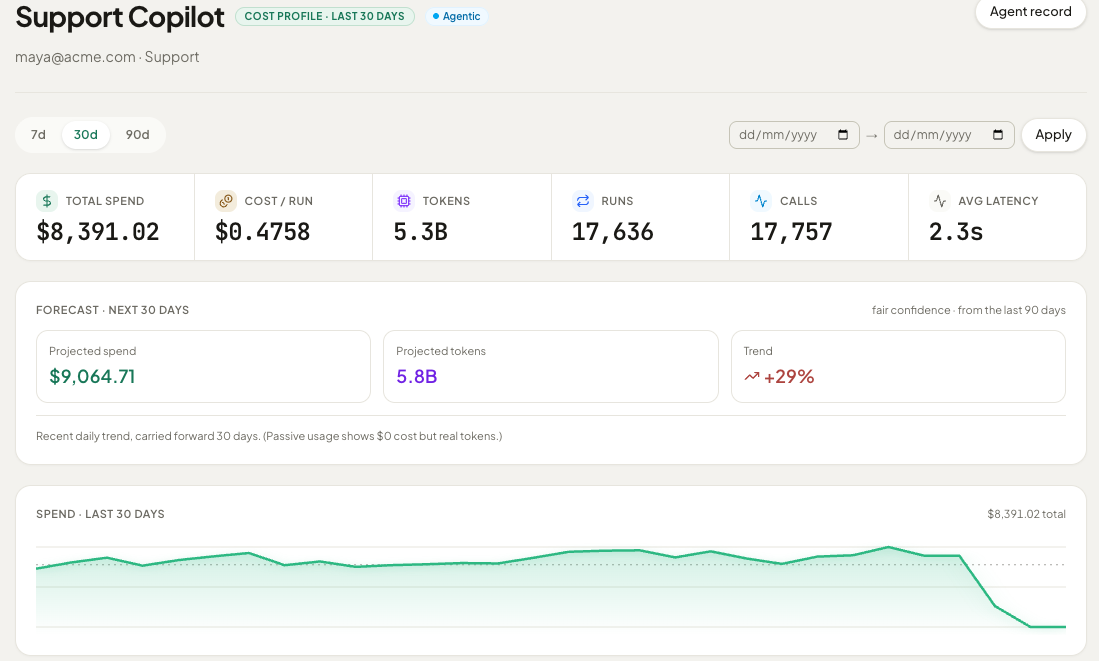
Know exactly what every agent costs
Unified multi-vendor cost and usage per agent, user, and team. Real-time alerts on spikes before the bill surprise, spend forecasts, and full per-agent drilldowns.
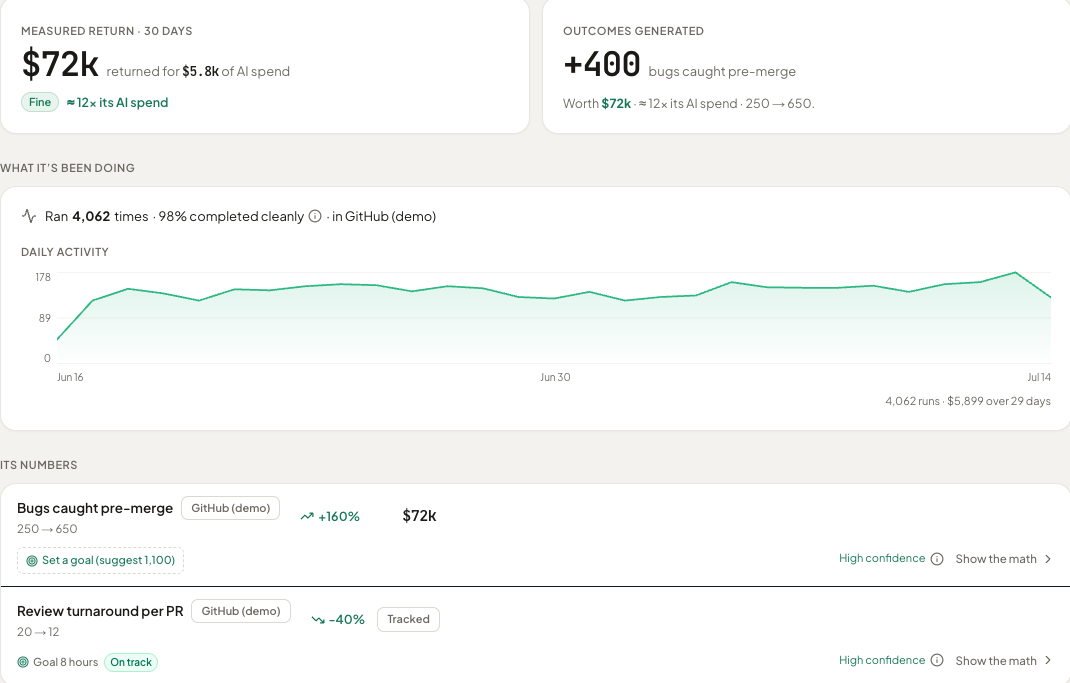
Know what your AI actually delivers.
Your support agent resolved 1,200 tickets this month. Jents shows its cost per ticket against your human baseline, the metrics it moved, and the dollarized bottom line: what it saved and whether it's hitting the KPI it was built for.
- Connects to 20+ business systems to track the actual metrics each agent moves.
- Jents suggests which metrics to track per agent, then measures them against cost and goals over time.
- Every agent gets an ROI profile: cost per outcome, improvement against baseline, dollarized impact, and the calculation behind it.
- The ROI dashboard: best and worst performers, ROI against spend, and progress on company goals.
One view for the CTO who explains the spend, and the CFO who questions it.
The hype wave is breaking.
AI spend is growing every month, and employees are already hooked. Token prices can rise at any time, and you're not in control of what you're paying for.
Companies are moving from "adopt everything" to "prove it's worth it", and boards and CFOs are starting to demand answers.
Every existing tool answers this for tech people only. Nobody connects AI activity to the business metrics the org actually cares about.
Built for the entire org, not just tech people.
Defend the AI budget with data
The CFO and board keep asking "what are we getting for this?", and there's no defensible answer.
Every AI dollar tied to a team, agent, and outcome, with ROI you can put in front of finance. Defend this budget, win the next, with data.
Govern and prove the program
Agents multiply across teams and vendors, shadow AI, duplicated work, and no way to prove the AI program is working without becoming the bad cop.
One control layer to govern what goes live, drive adoption across the org, and show the impact of every initiative you own.
See impact without the jargon
Support, sales, and ops run AI initiatives, but every control tool is built for engineers. The business side flies blind on whether AI actually improves operations.
See the business impact of every AI initiative in your departments, no technical skills needed. Track the KPIs you own against the AI brought in to move them.
Observability tells you what you spent. It can't tell you what you got.
vs. Vendor dashboards
OpenAI and Anthropic consoles are single-vendor, usage numbers only.
✦ Jents is cross-vendor, and connects usage to business impact.
vs. LLM observability
Datadog, LangSmith, Langfuse are built for engineers, they trace tokens and costs, and stop there.
✦ Jents is built for the whole org, and adds the layer they all miss: what the spend actually delivered.
vs. Build-it-yourself
Spreadsheets are manual, instantly stale, with no attribution, they break at scale.
✦ Jents is automatic from day one.
Observability tells you what you spent. It can't tell you what you got. Jents includes cost observability, and adds the ROI layer on top.
Jents works for you, not the other way around: auto-inventory, auto-documentation, AI-suggested metrics. Value from day one, without a rollout project.
SOC 2 infrastructure
Built on SOC 2 compliant infrastructure. SOC 2 certification in process.
Your records stay yours
Jents never accesses your data records, only aggregated numbers.
Nothing stored
We don't store your data. Only what's visible in the app.
Bring order and clarity to your AI chaos.
What runs, what it costs, who uses it, and what it's worth, in one place.